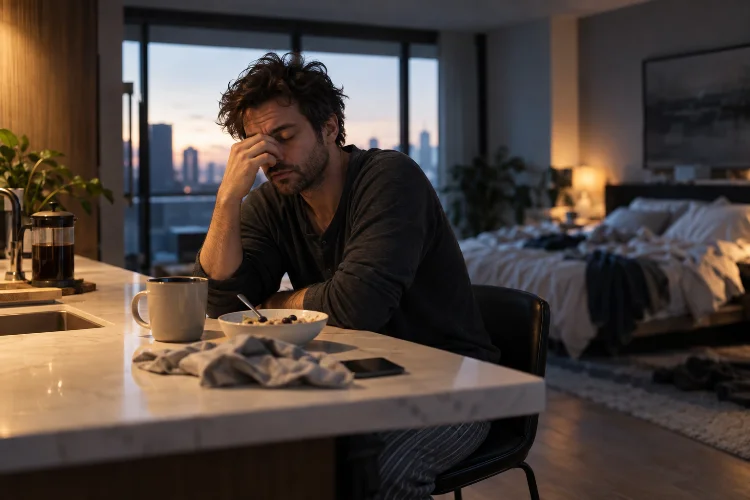
You can finish your workday, close the laptop, and still feel as if your body has not received the message that work is over.
Your shoulders remain tense. Your mind jumps between unfinished tasks. A notification instantly grabs your attention, and even when you finally sit down, relaxing feels strangely difficult.
This is where nervous system regulation strategies for high-stress lifestyles become useful. The goal is not to force yourself into a permanently calm state.
A healthy nervous system needs to become alert when something requires action and then gradually return toward recovery when the demand passes.
Stress involves interconnected brain, autonomic, hormonal, and behavioral systems rather than a simple on-off switch between “fight-or-flight” and “rest-and-digest.”
Research on the central autonomic network shows that multiple brain regions coordinate sympathetic and parasympathetic responses depending on the situation.
For busy people, regulation is therefore less about finding one perfect technique and more about designing repeated opportunities for the body to shift out of unnecessary activation.
Understand What Nervous System Regulation Really Means
The autonomic nervous system helps control functions such as heart rate, blood pressure, digestion, and breathing without requiring conscious effort.
During a challenge, sympathetic activity can increase to support action. Parasympathetic processes help support functions associated with recovery and physiological regulation.
Neither side is inherently good or bad.
You need activation to exercise, deliver a presentation, respond to an emergency, or solve a difficult problem. The problem is spending too much time in a state of unnecessary activation without enough recovery.
Chronic stress can affect health through autonomic and neuroendocrine pathways while also influencing behaviors such as sleep, eating, and physical activity.
A better goal than “always stay relaxed” is flexibility: activating when necessary and recovering efficiently afterward.
Use Slow Breathing as a Rapid Regulation Tool
Breathing is unusual because it happens automatically but can also be consciously changed.
That makes it one of the simplest ways to influence physiological arousal.
A large systematic review and meta-analysis involving 223 studies found that voluntary slow breathing increased several measures of vagally mediated heart-rate variability during breathing, immediately afterward, and following repeated training.
You do not need an elaborate protocol.
Try a simple slower-breath pattern
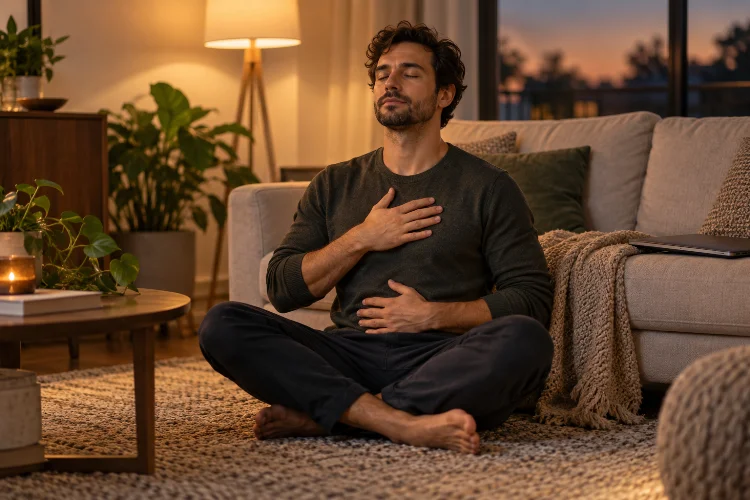
Sit comfortably and gradually slow your breathing rather than taking extremely large breaths. Many people find a slightly longer exhale comfortable—for example, inhaling gently for around four seconds and exhaling for five or six.
The objective is not to inhale as deeply as possible. Overbreathing can make some people light-headed.
Practice for several minutes during normal periods, not only during a crisis. This makes breathing regulaton a familiar skill rather than an emergency trick.
NCCIH notes that relaxation techniques such as slow breathing, progressive relaxation, guided imagery, and biofeedback are generally designed to encourage the body’s relaxation response.
Build Recovery Into the Workday
Many high-stress lifestyles have one major design problem: there is no transition between demanding periods.
One meeting ends and another immediately begins. Lunch happens in front of a screen. Work finishes, but email continues on the phone.
Instead of expecting one evening meditation session to undo ten hours of uninterrupted activation, create small recovery periods throughout the day.
A five-minute walk after a meeting, standing outside after lunch, stretching between focused work blocks, or simply sitting without looking at a screen can create useful transitions.
These pauses do not need to feel deeply relaxing.
Their purpose is to stop every demanding activity from merging into one continuous stress period.
A practicle approach is to connect recovery to events that already happen: after finishing a call, before lunch, after commuting, or before opening your laptop again.
Use Movement to Discharge Physical Tension
Stress often creates physical readiness for action while modern work requires sitting still.
That mismatch can leave people feeling restless, tense, or mentally overloaded.
Physical activity offers a useful outlet.
The CDC reports that even a single session of moderate-to-vigorous physical activity can reduce feelings of anxiety and improve sleep quality, while regular activity brings broader physical and mental health benefits.
Exercise does not need to become another source of pressure.
On demanding days, a brisk 20-minute walk might be more realistic than an intense gym session. On other days, resistance training, cycling, running, swimming, or sport may feel better.
The best movement strategy is usually one you can maintain consistantly.
Think of exercise not only as fitness training but as part of your daily recovery architecture.
Protect Sleep as Nervous System Maintenance
It is difficult to regulate daytime stress when recovery at night is consistently compromised.
Adults ages 18–60 generally need at least seven hours of sleep, although individual needs vary. Adequate sleep supports mood, attention, memory, metabolism, and stress management.
The challenge is that high-stress lifestyles often steal sleep from both ends.
People work later, use screens longer, wake early, consume more caffeine, and mentally carry unfinished problems into bed.
Sleep regulation begins before your head reaches the pillow.
Create a repeatable shutdown period. Reduce work communication near bedtime when possible, dim unnecessary stimulation, and keep waking and sleeping times reasonably predictable.
WHO also recommends maintaining routines, getting sufficient sleep, exercising regularly, and limiting media exposure when it increases stress.
You cannot control every stressful event, but you can make the evening enviroment less stimulating.
Reduce Sensory and Digital Overload
Your nervous system responds not only to major life events but also to repeated signals demanding attention.
Emails, messages, headlines, alarms, multiple browser tabs, background television, and constant phone checking can create a day full of micro-interruptions.
The solution is not necessarily abandoning technology.
Design boundaries around it.
Turn off notifications that do not require immediate attention. Keep your phone outside your direct visual field during focused work. Check messages in batches instead of reacting instantly to every alert.
WHO specifically suggests limiting news consumption when following the news repeatedly increases stress.
You can apply the same principle more broadly: reduce unnecessary inputs when your attention is already overloaded.
A quieter workspace or ten minutes without a screen may sound insignificant, but small reductions in stimulation can make recovery more managable.
Use Predictable Routines to Reduce Mental Load
Uncertainty itself can be stressful.
If every day requires deciding when to eat, exercise, work, rest, and sleep, even simple activities generate additional cognitive effort.
Predictable routines reduce some of this friction.
You might establish a morning walk, a fixed lunch window, an afternoon screen break, or a consistent time when work communication ends.
WHO recommends maintaining a daily schedule that includes meals, physical activity, responsibilities, relationships, and recreation as part of stress management.
Routine does not mean rigidity.
Think of it as creating default behaviors so you do not need maximum motivation every time.
When stressful periods arrive, those defaults become especially valuable because good habits require fewer decisions.
Remember That Regulation Can Be Social
People sometimes approach nervous system regulation as a completely individual task.
In reality, supportive relationships can strongly influence how stress feels.
Talking with someone you trust may reduce uncertainty, provide perspective, or simply create a sense that you are not managing everything alone.
The CDC notes that strong social connections can support stress management, mental health, healthy behaviors, and sleep.
This does not mean becoming more socially busy.
A crowded calendar full of obligations can increase stress.
Focus instead on relationship quality. One calm conversation, a walk with a friend, dinner with family, or asking a colleague for practical help may be more restorative than another hour spent alone trying to “optimize” your nervous system.
Sometimes regulation happens through connection.
Stop Chasing Constant Calm
A common mistake in wellness culture is treating every elevated heartbeat, stressful thought, or moment of tension as evidence that the nervous system is “dysregulated.”
Normal life includes activation.
An important presentation should increase alertness. Exercise raises heart rate. Excitement changes breathing. Difficult conversations can create temporary tension.
The objective is not to remove those responses.
What matters is whether you can recover afterward and whether stress is interfering with sleep, concentration, relationships, physical health, or normal daily functioning.
Avoid turning heart-rate variability scores or wearable-device data into another source of anxiety as well.
These measurements can provide useful information, but they are influenced by many factors and should not become a daily judgment of whether your nervous system is functioning correctly.
If persistent anxiety, panic, insomnia, trauma-related symptoms, or stress significantly interferes with daily life, professional support is more appropriate than continually adding self-regulation techniques. WHO recommends seeking help when coping with stress becomes difficult.
Nervous system regulation for a high-stress lifestyle is less about finding a magical vagus-nerve hack and more about building reliable recovery into everyday life.
Slow breathing can influence autonomic activity, while movement, sufficient sleep, reduced digital stimulation, predictable routines, and supportive relationships create broader conditions for recovery.
The most effective strategy is usually a combination rather than one isolated technique.
Start small. Add a five-minute transition after demanding work, protect a consistent bedtime, silence unnecessary notifications, or take a short walk when physical tension builds.
The goal is not to remain calm every minute. It is to develop enough flexibility to meet demanding situations, recover afterward, and avoid carrying unnecessary activation through the entire day.